US Crypto Regulation 2026: CLARITY Act Hits the Senate, GENIUS Act Is Now Law — What It Changes for the Market
2026 is the year US crypto regulation stopped being an abstract "someday" and turned into a concrete legislative calendar with real dates. While the market was busy watching Bitcoin sink to its lowest levels since 2024, Washington quietly assembled the entire architecture of a new digital-asset regime. Here's what's already law, what's about to clear the Senate, and why it matters directly for your portfolio.
The 2026 Timeline at a Glance
- GENIUS Act — passed and signed. Federal rules for payment stablecoins. Already law.
- CLARITY Act — advanced by the Senate Banking Committee on May 14 (15–9), placed on the Senate calendar for floor consideration on June 1.
- SEC + CFTC — joint interpretation (March 2026) on how securities laws apply to crypto assets; digital assets named the SEC's #1 objective in its 2026–2030 strategic plan.
GENIUS Act: Stablecoins Enter Mainstream Finance
The GENIUS Act is the first US federal law to build a full regime for payment stablecoins. It cleared the Senate on a solid 68–30 vote and has already been signed. The core requirements: full 1:1 reserve backing in liquid assets, regular audits, and — an important nuance — issuers are prohibited from paying users interest or yield simply for holding a stablecoin balance. Activity-linked rewards are still allowed, but the passive "stablecoin savings at X% APY" model is off the table.
In practice: USDC, PYUSD and other regulated stablecoins gain a clear legal status and a path into traditional banking. Meanwhile DeFi protocols that built their mechanics on "yield for holding a stablecoin" will have to rethink the model — at least for US users.
CLARITY Act: Who Regulates — SEC or CFTC?
If GENIUS is about stablecoins, the CLARITY Act (Digital Asset Market Clarity Act) settles the defining question of the last decade: who actually regulates crypto. The bill splits the market so that spot markets for "digital commodities" fall under the exclusive jurisdiction of the CFTC, while assets sold as investment contracts stay with the SEC.
On May 14, 2026 the Senate Banking Committee advanced the bill 15–9. On June 1 a new version of the Senate bill was published and CLARITY was placed on the Senate calendar under General Orders — formally eligible for full floor consideration. That's closer to the finish line than the crypto industry has ever been.
What Still Has to Happen
To become law, CLARITY must be reconciled with the Senate Agriculture Committee's version, win 60 votes on the floor, be reconciled with the House-passed version, and be signed by the President. The clock is tight: the approaching 2026 midterms are a genuine political risk to the whole package.
The Three Buckets the Market Splits Into
The final regulatory architecture sorts every crypto asset into three buckets — and which one a token lands in decides almost everything: where it trades, who oversees it, and how expensive it is for the issuer to exist.
- Digital Commodity — CFTC oversight. Low regulatory risk. BTC, ETH and a short list of sufficiently decentralized assets.
- Investment Contract Asset — SEC oversight. Heavy compliance: registration, reporting, listing restrictions. The main risk for most altcoins.
- Payment Stablecoin — GENIUS Act regime. 1:1 backing, audits, no passive yield.
Check Your Portfolio Before the Law Passes
Markets don't like pricing in regulatory risk in advance — which is exactly why an attentive investor has a window. While the law isn't signed yet, you can calmly assess each asset: does it fall under the CFTC (low risk) or the SEC (heavy compliance and likely delistings)?
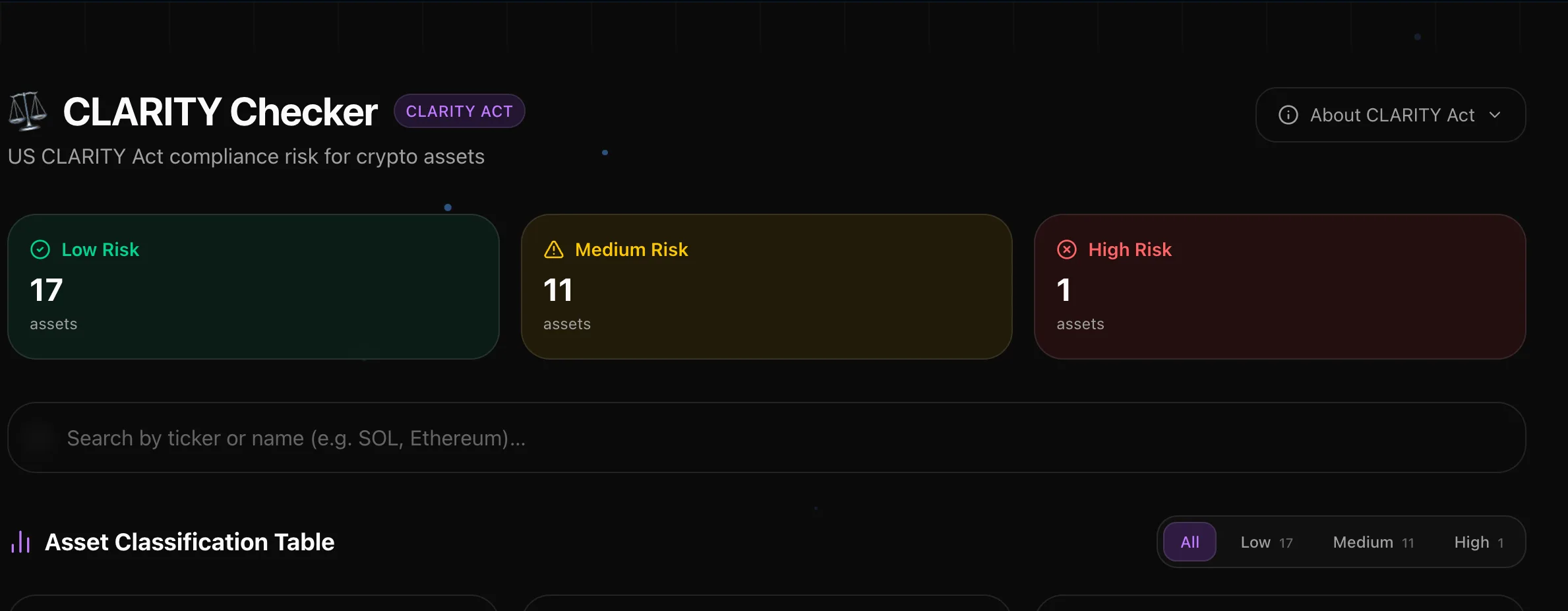
CLARITY Checker on NeuroTrader
We keep the tool current as the law moves through Congress. It shows you:
- Risk level Low / Medium / High with full reasoning
- Whether the token is on the digital-commodity list under the CFTC
- Live search for any token, not just our curated set
- Compliance Score 0–100 based on real market data
Bottom Line: The Rules Are Being Locked In
US regulation is moving from uncertainty to a schedule. GENIUS is law, CLARITY is on the doorstep of a Senate vote, and the SEC and CFTC have drawn their jurisdictional lines. For large assets like BTC and ETH this is mostly a positive — a clear status draws institutions in. For small altcoins with no real product, it's a deadline.
The best thing you can do right now is not to guess from headlines, but to check your specific assets against the law's criteria and decide deliberately. Not out of fear — but from understanding how the field is changing.