The Three Drives Pattern on BTC: How to Trade the Reversal Without Guessing
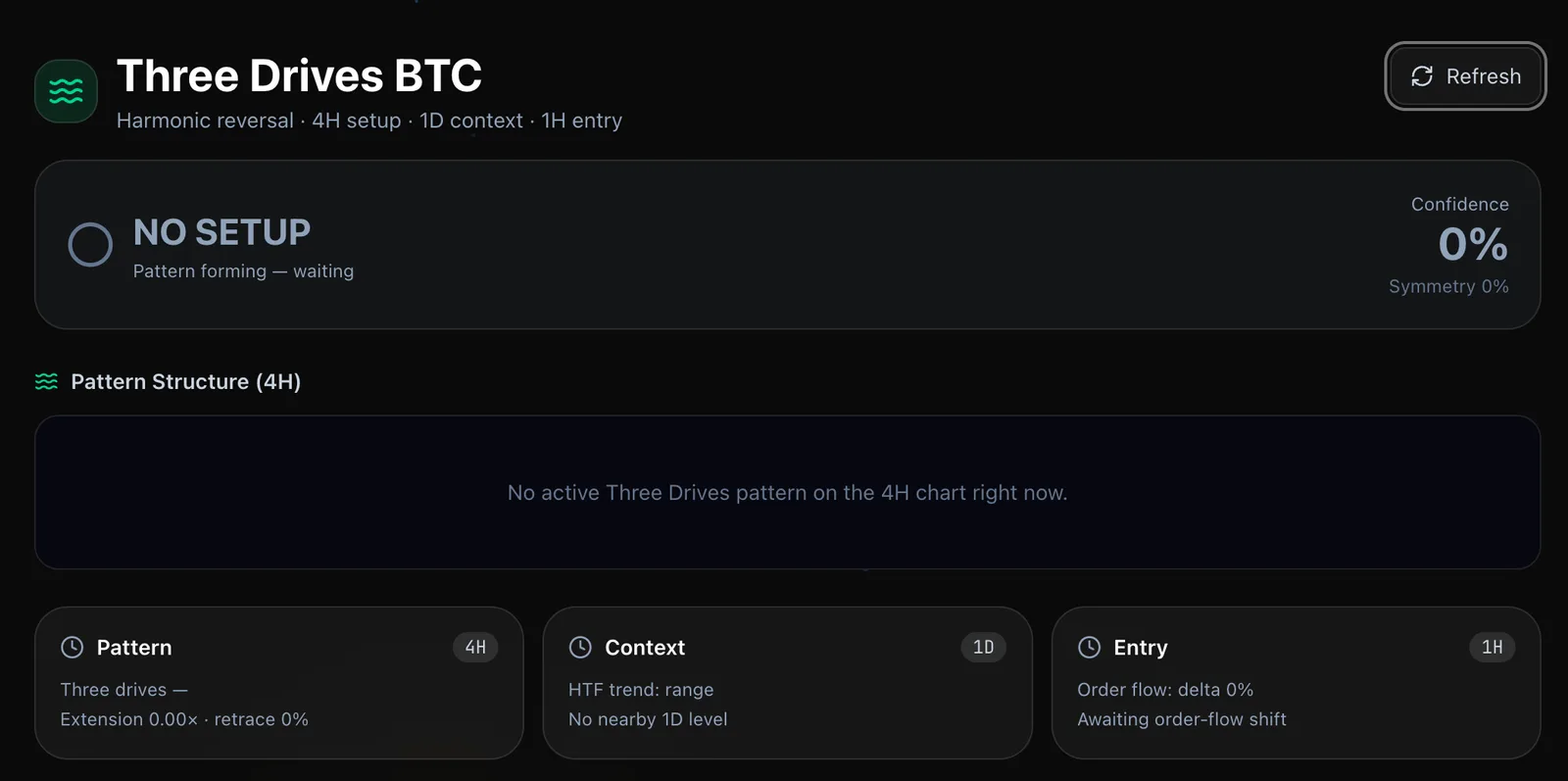
Three Drives is one of the more reliable harmonic reversal patterns: the market makes three consecutive "drives" in one direction, each one extending further than the last, then reverses against the whole sequence. The problem is spotting it manually in time — you'd need to track extension and retrace symmetry in your head while also checking the higher timeframe so you don't fade a strong trend. The Three Drives BTC indicator on NeuroTrader takes that work off your plate: it scores the pattern, the context and the entry separately across three timeframes and only signals once all three line up.
What the Three Drives Pattern Is
The pattern is three "drives" with two corrections between them. For a long setup that's three drives down; for a short, three drives up. The key requirement is symmetry: each drive's extension relative to the previous one should land near the Fibonacci ratios 1.0, 1.272 or 1.618, and the corrections between drives should retrace roughly 61.8% of the prior move. The closer those numbers sit to the ratios, the higher the symmetry score — and the more likely the market reverses after the third drive instead of continuing.
On NeuroTrader the pattern is computed on BTC's 4-hour chart. The indicator doesn't blindly grab the last three swing points — it enumerates combinations of recent pivots and picks the most symmetric triple whose third drive happened recently. That matters because a real Three Drives almost never shows up as three perfectly consecutive swings with no noise in between.
Why One Timeframe Isn't Enough
A symmetric pattern on the 4H is only half the picture. Fading a move without context often turns into catching a falling knife. That's why the indicator builds its signal from three layers, and each has to confirm its own piece:
- Pattern (4H) — the Three Drives structure itself: direction, drive extensions, retrace percentage and overall symmetry.
- Context (1D) — the higher-timeframe trend (via SMA20) and the nearest daily level. A reversal that aligns with the higher-timeframe context, or lands on a real daily level, plays out far more often than a reversal fading the trend in open air.
- Entry (1H) — order-flow confirmation on the hourly chart. Until 1H order flow actually shifts toward the reversal, the indicator withholds the entry signal — even if the 4H pattern already looks symmetric.
The screenshot above shows exactly the state when no pattern exists yet: status "NO SETUP", confidence and symmetry both at zero, all three panels waiting. That's the indicator's normal, most common state — most of the time the market simply isn't forming a clean three-drive sequence, and the correct move is to wait rather than invent a setup that isn't there.
How to Enter Without Catching a Falling Knife
The classic mistake with reversal patterns is entering right after the third drive without waiting for confirmation. The indicator is built specifically to rule that out:
- Wait for the three-drive sequence itself to form on the 4H with real symmetry — you'll usually see it already drawn in the Pattern Structure chart.
- Check the 1D context: is the trend aligned, or is there a nearby daily level? If context doesn't line up, confidence will read lower and it's worth waiting.
- Wait for the 1H entry: order flow has to actually shift toward the trade, not just "look close." This is the last filter before a LONG/SHORT signal fires.
- Use the ready-made Entry / SL / TP levels the indicator computes automatically from the pattern's structure — the stop sits behind the third drive, the target sits on the correction's range.
In short: the pattern gives direction, the context gives permission to trade that direction, and the 1H entry gives the trigger moment. Until all three line up, there's no trade — and that's a deliberate choice by the indicator, not a bug.
The Three Drives BTC Indicator on NeuroTrader
On the NeuroTrader platform, the indicator runs in real time and gives you:
- Auto-detected Three Drives pattern on BTC's 4H chart — direction, extension, retrace, symmetry
- Higher-timeframe context from the 1D chart (trend + nearest level)
- 1H order-flow entry confirmation, no falling-knife entries
- Ready Entry, SL and TP levels computed from the pattern's structure
- A signal sent straight to Telegram in two phases: first "Setup Forming" as the pattern builds, then "Entry" once the trade is actually confirmed — so you don't miss it while away from the chart
Conclusion
Three Drives is a strong pattern, but its edge comes from symmetry and confirmation, not from eyeballing a reversal. NeuroTrader computes all of it across three timeframes and pushes a ready signal to Telegram the moment the pattern, the context and the entry all agree — all that's left is to execute the trade at the levels it hands you.
A ready Three Drives signal in Telegram
Pattern, context and entry are scored for you across three timeframes — the signal lands the moment they all agree.