Trading Couch: The AI Trading Psychologist You Can Actually Talk To
The stop-loss hit. Or worse — you moved it, and the loss came in three times bigger than planned. Your hands are shaking, your head is a mess, and the first urge is to open a new trade immediately to win it back. Sound familiar?
In that moment, most traders have no one to talk to. Friends and family won't get it — to them, "I lost $2,000 on crypto" sounds like recklessness, not a normal part of the risk. Admitting it in a public forum or community chat feels humiliating — those spaces are for flexing profits, not dissecting failures. So the emotion doesn't go anywhere — it gets swallowed and spills into the next, even more impulsive trade.
⚠️ Disclaimer
This is not investment advice and not a substitute for professional psychological or medical care. Trading Couch is an educational tool for working through trading psychology. Trading involves risk of capital loss.
The Problem: Traders Stay Silent About What's Breaking Them
A blown trade rarely wrecks an account on its own. What wrecks it is what happens after: anger at yourself, denial ("the market is manipulated"), shame — and suddenly you're revenge-trading the market with the next position, no plan attached. This is classic revenge trading, and almost every trader has been through it at least once.
The problem is that in that moment you need someone who will listen without judgment and help you think clearly — not someone who says "you got rekt" or "your own fault." A professional trading psychologist is expensive and works by appointment, but the emotion hits right now, at 2am, staring at a red chart.
What Trading Couch Is
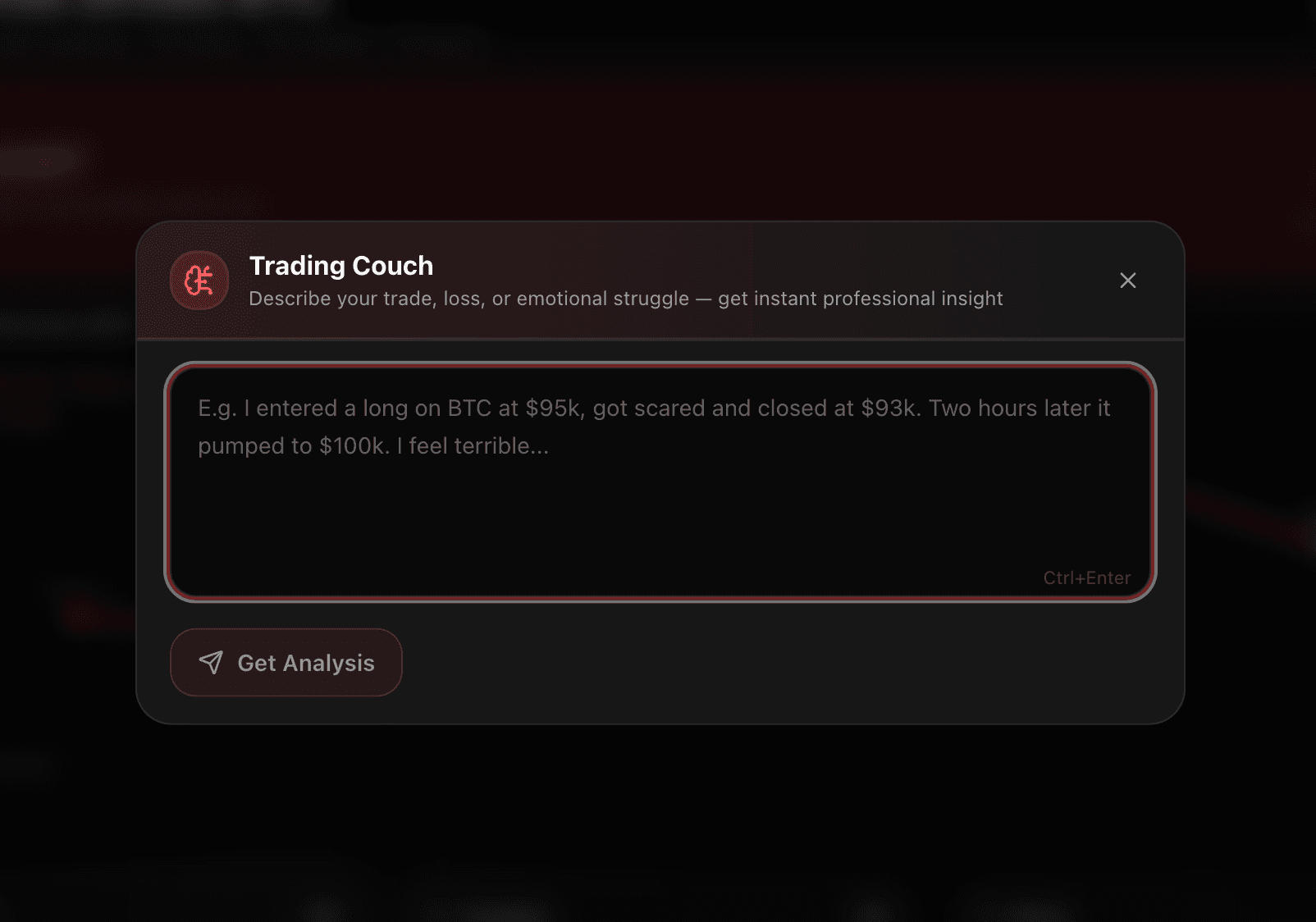
This is exactly the situation NeuroTrader's Trading Couch was built for — a built-in AI conversation partner that works as a trading psychologist. You open the chat, describe what happened — the trade, the loss, the emotion — and get a real breakdown:
How Trading Couch Responds
Acknowledges the emotion
Briefly confirms that what you're feeling is normal and understandable
Names the cognitive bias
FOMO, loss aversion, revenge trading, overtrading, confirmation bias — with the exact term, not vague talk
Breaks down what went wrong
From a trader-psychology angle, not technical analysis
Gives 2-3 concrete steps
What to do right now to get discipline back
Never gives financial advice
Only psychological analysis — what to buy or sell is entirely up to you
It replies in whatever language you write in, and it's available at any hour — the crypto market never sleeps, and neither does your panic after a 4am liquidation wait for a psychologist's office hours.
Why This Works Better Than Staying Silent
The core value is privacy. You don't need to explain to a friend why you "lost it again," and you don't need to post in a community chat where half the room will gloat. You're talking to an AI that won't remember you badly and won't tell anyone.
The second value is speed. The emotion after a bad trade lives for minutes, an hour at most. If in that window you get a structured breakdown — "this is classic revenge trading, here's what happened psychologically, here are two steps" — you're far more likely to stop than if you sit alone spiraling further.
Typical Situations Trading Couch Helps With
Your stop-loss hit and you want to re-enter immediately to win it back
You moved the stop 'for luck' and the loss came in far bigger than planned
You blew a large amount and can't bring yourself to open the terminal tomorrow
You FOMO'd into a hyped move and now you're down, angry at yourself
After a winning streak you took an oversized risk and lost it all in one trade
Not Therapy — First Aid for Discipline
It's important to know the boundaries: Trading Couch is not a replacement for a therapist and not medical care. If your emotional state extends beyond a single trade, that's a reason to see a professional. But as a first-aid tool for trading psychology specifically — the moment you need to quickly name the bias, defuse the intensity, and avoid making new mistakes under emotional pressure — that's exactly the job it was built for.
A good practice is pairing Trading Couch with your trade journal in Notes: right after talking it through with the coach, log the takeaway as a note. That turns an emotional conversation into a written pattern you can review a month later.
Try It Right Now
Open Trading Couch from the NeuroTrader menu and describe the last trade that's still bothering you. No need to prepare — just write what happened and how you feel.
The market doesn't ask whether you're emotionally ready. But now you have somewhere to go at 3am after a bad trade — instead of opening a new position out of anger.