Strategy First, Trade Second: Why the Plan Matters More Than the Feeling
Most losing trades don't break down at entry — they break down earlier, at the point where the trader never actually wrote down what they were doing or why. Open the chart, see some movement, it "looks like a reversal" — and the position is already open. No defined entry, no stop, no target. Everything after that gets decided on the fly, and the market rarely forgives that.
The gap between a consistently profitable trader and someone bleeding out their account is almost never about who reads the chart better. It's about who wrote a plan before the trade, and who didn't.
Plan First, Click Second
Before opening a trade, three questions need answers on paper, not just in your head: where's the entry, where's the stop-loss, where's the target. If even one of those three is "I'll figure it out as it goes," the trade isn't ready yet. The entry is a specific level or condition — a breakout, a bounce off a zone, an FVG, a pattern — not a vague "feels like it's about to move." The stop is a fixed percentage or level that invalidates the idea if the market crosses it. The target is a realistic take-profit level decided in advance, not "we'll see."
A written plan gives you something a thought in your head never does: the ability to come back afterward and honestly check whether you actually did what you planned, or started improvising halfway through.
How to use it
Before you click buy or sell, describe the trade in one paragraph: asset, entry point, reason for the entry, stop, target. If the paragraph doesn't come together cleanly, the plan isn't ready.
After Entry — Hands Off
The hardest part of trading doesn't start before the trade — it starts the moment it's open. Stop and take-profit are already set, and the honest move from there is to leave them alone. The trade closes on the stop or on the target. The market itself tells you whether the plan was right or wrong.
Trailing the stop to breakeven is a legitimate technique, and plenty of traders use it. But there's a familiar failure mode: price moves toward the target, the stop gets trailed up, the market pulls back and clips the trailed stop — then continues in the original direction, without you in the position anymore. That's exactly why a fixed stop at a predetermined risk percentage is often more reliable: you know your maximum loss ahead of time, and the market can't shake you out over a minor wiggle on the way to the target.
Scalping Is Also a Strategy — Just With Different Math
An alternative approach is many small, fast trades instead of one with a wide target. That's a valid style too, but it comes with fees on every open and close. Trade frequently enough and commissions eat a real chunk of the profit — a setup that looked good on paper can turn negative once fees are factored in. Same underlying logic applies: run the math first — expected profit net of fees across a series of trades — then decide if that style actually fits.
Risk Management Is a Fixed Number, Not a Wish
For every trade — or at minimum for your overall approach — you need a clear, fixed answer to how much you lose if the plan fails and how much you make if it works. Not "roughly," an actual percentage of the account. That discipline, not lucky entries, is what determines whether you stay in the game long enough for the statistics to start working in your favor.
Consistently making money in the market over the long run is rare. But it isn't magic or luck — it's an approach: a written plan before every trade, fixed risk, and an honest review after the trade closes.
Testing the Plan Before Real Money Is on the Line
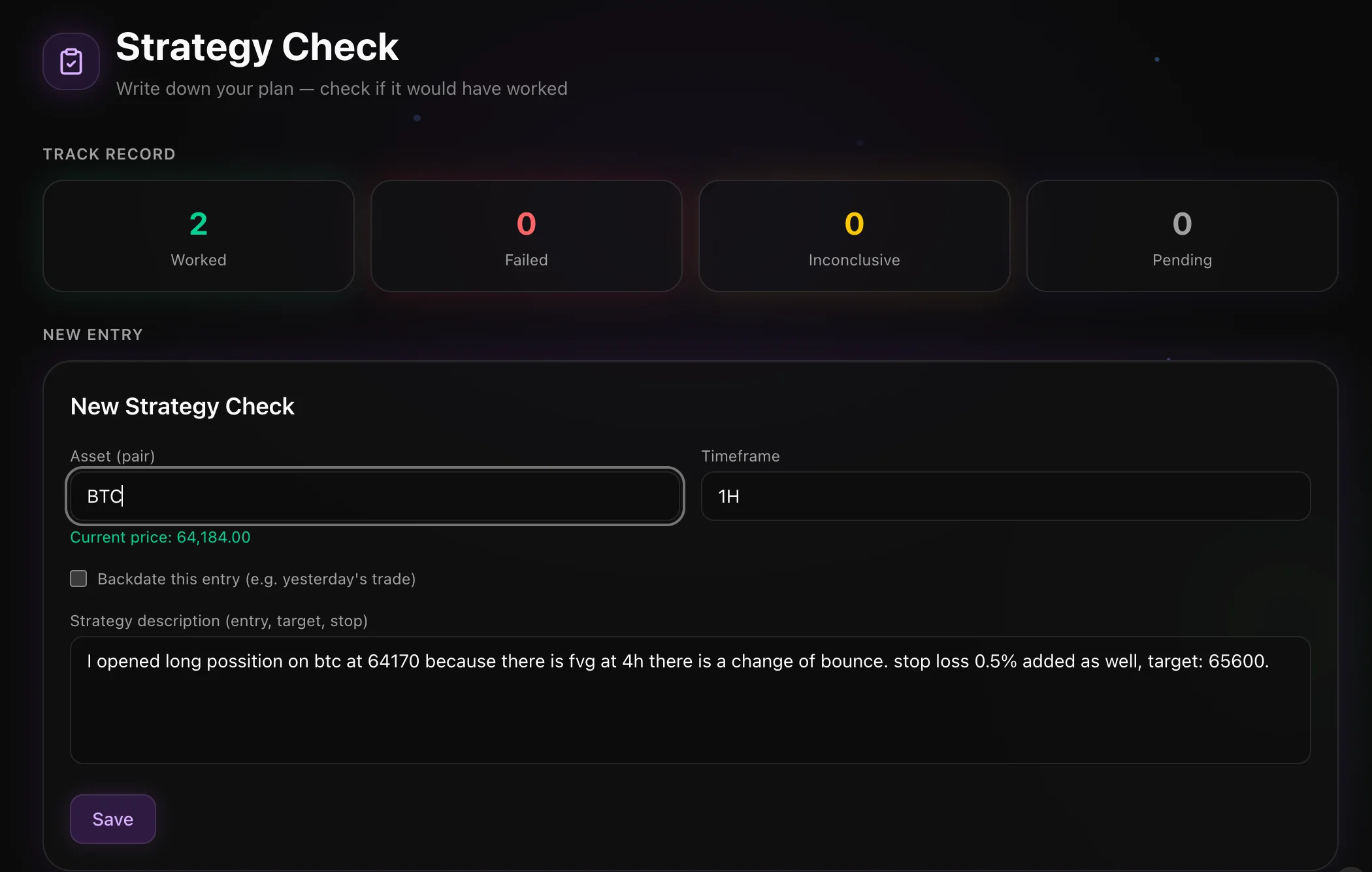
Writing the strategy down is only half the work. The other half is checking whether it would have actually worked, against real data, not hindsight guesswork. That's what Strategy Check on NeuroTrader is for: you describe a hypothetical plan — asset, entry, reason, stop, target — the same way you'd describe a real trade, and the algorithm checks it against the actual candles for that asset and timeframe to show whether the plan would have worked or not.
The screenshot above is exactly that kind of entry: BTC, long from 64170 off a 4H FVG expecting a bounce, a 0.5% stop, a 65600 target. Nothing extra — just what's actually needed to test the idea: the asset, the timeframe, and the plan written out in plain language, the same way you'd explain the trade to yourself.
It isn't a signal or a recommendation — it's a discipline exercise for planning. The more often a plan gets tested before real money is behind it, the faster it becomes clear which setups hold up consistently and which only look good in the moment.
In short
Entry, stop and target — written down before the trade, not invented during it. After entry, the stop and take-profit do their job; you don't interfere. Risk per trade is a fixed number, not a feeling. And a regular, honest check of the plan against what actually happened in the market.
The market doesn't reward whoever guesses best. It rewards whoever can follow, again and again, a plan they wrote down themselves before the trade began.
A plan needs a repeatable trigger. Optimal Entry waits for a pullback inside the daily trend, confirmed by a structure shift on 15m.
Плану нужен воспроизводимый триггер. Optimal Entry ждёт отката внутри дневного тренда, подтверждённого сломом структуры на 15m.