Too Much Information, Too Little Signal: How We Built the Filter
Open a trader's phone. Four Telegram signal channels, a YouTube morning breakdown, an Instagram post where someone confidently shows a screenshot of a winning trade, TradingView full of other people's ideas, a couple of paid analytics platforms, a news feed, X full of opinions, and three tabs of charts. All of it describes the same market — and all of it disagrees.
A trader's problem today isn't a shortage of information. It's that the volume of it can't physically be processed. By the time you finish the third source, the first one is stale. While you reconcile two opinions, price moves. And the decision still gets made on gut feel — only now with the added feeling that you've "done the analysis".
Why more sources don't mean better decisions
There's an uncomfortable pattern here: as the number of sources grows, confidence grows faster than decision quality. You read ten opinions, find the ones that match the view you already had, and enter feeling confirmed. What you actually did was filter the noise in your own favour.
The second problem: a single signal on its own is close to a coin flip. Any indicator taken alone is wrong regularly — that's its normal operating mode, not a malfunction. What carries weight isn't one signal but agreement between independent sources looking at the market from different angles: price structure, volume, the behaviour of large participants, the macro backdrop.
That is exactly what can't be done by hand in the ninety seconds you have to decide. It's a job for a system that runs continuously.
What we built
We built an analytics system that reads dozens of market data sources in parallel and pulls them into one core: market structure, order flow and CVD, whale wallets, spot ETF flows, funding and open interest, the liquidation map, macro data, seasonality and news sentiment. Each one is a separate read on the same market.
Those readings are then weighted. This is deliberately not a one-source-one-vote headcount: price action and real market participation outweigh mood and opinion. Three weak sentiment inputs shouldn't outvote the price action itself — which is precisely what a simple tally would let them do.
When enough independent sources line up on one side, the system issues one signal — direction, level and context. When they disagree, it says plainly that there is no clear edge. That isn't a gap in the product; it's the most valuable message it can send. The day you didn't trade into contradictory data saves more than a good entry makes.
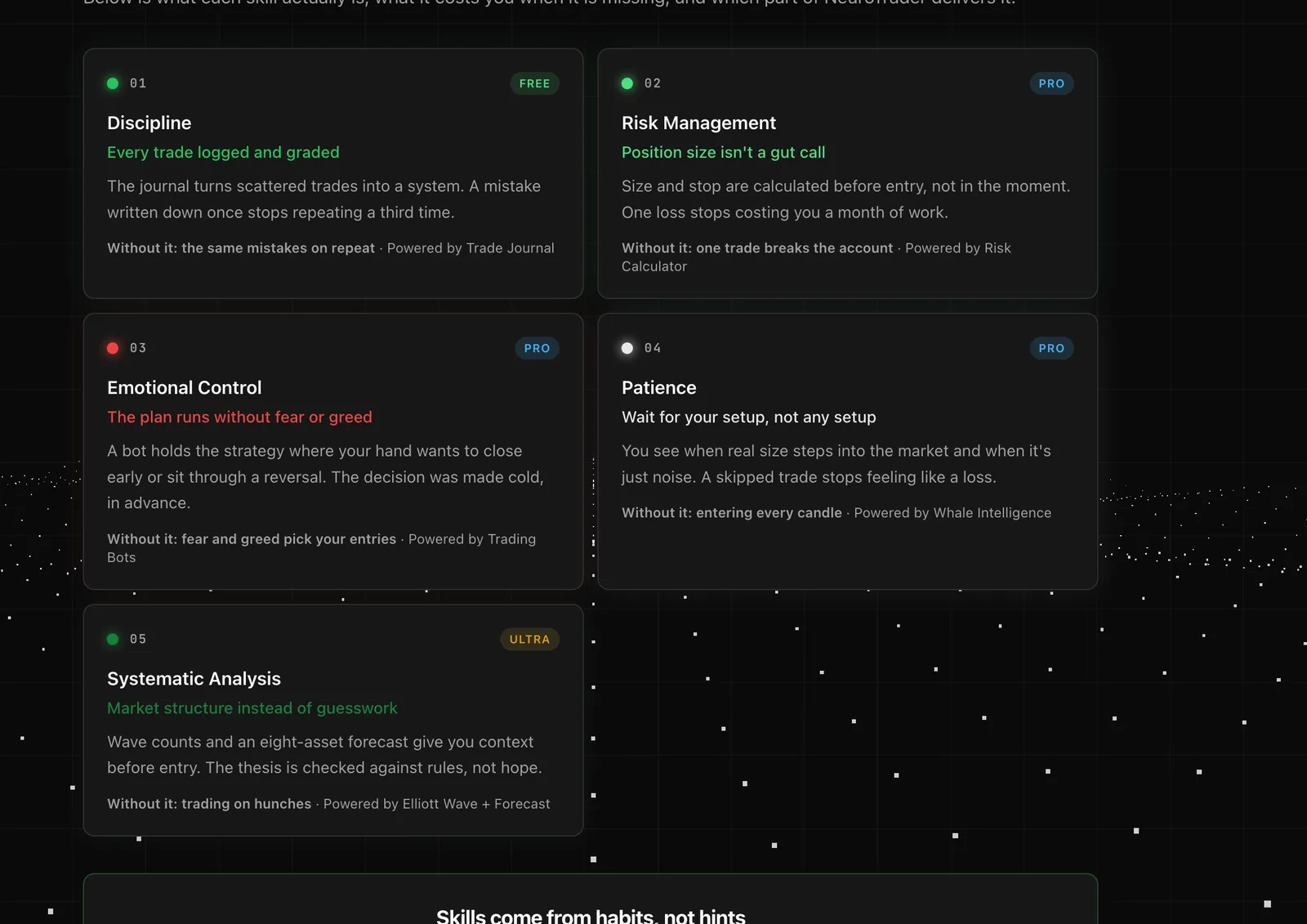
Minimal noise is a design choice, not a side effect
A channel that sends twenty signals a day is useless — you stop reading it by day three. So the alerts are built the other way round: they stay silent while nothing is happening.
A signal goes to Telegram the moment it forms, with the reasoning attached: which factors agreed, which pushed back, and what would invalidate it. You're reading an argument, not an alert with an arrow on it. Macro events — Fed decisions, CPI, NFP — get their own heads-up roughly an hour before the release, because learning about those after the fact is pointless.
Markets: the choice is yours
One reason traders sit in information noise is that they watch a single market and feel obliged to find a trade there every day, even when there isn't one. The system covers five at once:
- Crypto — BTC, ETH
- Stock market — S&P 500, ES futures, NASDAQ
- Precious metals — gold and silver
- Oil — Brent
- Forex — EUR/USD, GBP/USD, USD/JPY
The engine knows what makes each market different and doesn't pretend otherwise. Whales, liquidations and the fear & greed index exist only in crypto. Spot FX has no honest volume, so the participation check there is marked unavailable rather than faked. For gold and EUR/USD the macro backdrop is inverted — they trade against dollar strength, not with it.
The practical point is simple: if crypto is quiet today but there's an edge in gold or the indices, you see it without opening five more tabs.
What stays with you
This part deserves total honesty. The platform never connects to your account and never opens anything for you. It brings everything it knows to the moment of the decision. What remains yours:
- The venue. You trade wherever suits you and wherever the instrument is.
- Risk management. How much of your deposit you're willing to lose on this trade is your call.
- Position size and stop. The calculator does the maths, but you set the risk figure.
- The decision itself. Take it, skip it, or wait for the next one.
You can use the platform deeply — open the indicators, work through the structure, test your thesis against the data. Or you can strip it down: wait for the Telegram signal, read the reasoning, decide. Both are legitimate ways to run it.
What this is not
It is not a guarantee and it is not financial advice. Markets are probabilistic: any signal is an estimate of likelihood, never a promise. The value is in reading many independent sources at once — faster and more consistently than is possible by hand — and in keeping an honest record of what worked and what didn't. We provide information. The final decision, and the responsibility for every position you open, stay with you.
Conclusion
The flow of information isn't going to shrink — it will only grow. The one thing you can change is how much of it reaches you. Not twenty opinions but one verdict with its reasoning. Not twelve tabs but a single message when there is genuinely something to say. Everything else is silence, and that's the point.
See the whole path
From dozens of sources to a Telegram signal and your decision — an interactive scene, no account needed.