Trader or Investor: Let Your Psychology Decide, Not Your Ambition
The question «is it better to be a trader or an investor» is usually asked the wrong way. It is asked as if one path were objectively more profitable and the only job were to pick correctly. In reality both work, and both make money for the people they suit. The question is not which earns more. The question is what kind of person you are.
The market does not ask who you would like to be. It shows you very quickly who you already are. So an honest choice starts with a few uncomfortable questions rather than with charts and strategies.
Three questions that settle it
First: do you have patience? Not «can I wait a week», but the ability to calmly do nothing for months until conditions line up. If waiting causes you physical discomfort, if a day without a trade feels wasted, that is a signal worth taking seriously.
Second: what do you do with emotion? When a position goes against you, do you follow the plan or do you follow the fear? After a loss, do you want to win it back immediately? If so, your strategy will not break in the market. It will break inside you, at the moment your finger reaches the button.
Third: are you willing to study for years? Not watch a few videos, but learn systematically, keep statistics, review your own mistakes and change your approach based on numbers. Without that, trading becomes expensive roulette.
If those answers made you uneasy, that is not a verdict and not a reason to leave the market. It only means your path has a different name.
If you are impatient, investing is your answer
It sounds like a contradiction: how can an impatient person invest for years? But that is exactly how it works. Trading demands patience in the moment — sitting in front of a chart and not entering while your hands itch. Investing demands patience in the background, where the decision is made once and after that your only job is to stay out of the way.
For someone who wants to close a trade the second it moves against them, whose emotional control is the weak link, the rational answer is to become an investor. And the tool has been known for decades: DCA, dollar cost averaging. You buy small amounts, regularly, on a schedule rather than on inspiration. Every week or every month, the same size, regardless of what the market is doing or what the news is saying.
Here is where its psychological strength lies. DCA removes exactly the step where an emotional person loses money: the decision. You do not have to guess the bottom. You do not have to judge whether it is expensive or cheap today. You do not have to fear that you bought the top, because if you buy in steps for two years, your top is one purchase out of a hundred. For a DCA investor a falling market is not a disaster, it is simply a better price on the next buy.
The horizon is not a month or a quarter. A sensible range is two to five years. You are in no hurry, you build the position in steps, and you give the asset time to go through its cycle. On that horizon the daily swings that burn a trader's nerves simply stop being events.
The important part is admitting it honestly: an investor is not a trader who did not make it. It is a different profession with a different unit of time. The person who calmly adds to a position for the seventh month in a row, without checking quotes daily, often ends up ahead of the active trader who started with the same capital and gave it back in fees and nervous entries.
If you are stable and willing to learn, trading is open to you
The other side. Some people genuinely have the temperament: emotionally steady, not broken by a losing streak, no urge to win it back, able to wait for their entry. They have a real goal of learning to trade and real interest in the process — reading, counting, testing hypotheses, keeping statistics.
For those people trading works. But one illusion has to go first, because it is the reason most people leave the market inside a year.
Trading is not a fast business. It is just a business. And it goes through the same stages as any other. First you invest in education: time and money spent on understanding how markets, risk, volume and liquidity actually work. Then you build a strategy — your own specific description of where you enter, where you exit, what you risk, and under what conditions you do not trade at all. Then comes the longest stage: learning to follow that strategy when it hands you three losses in a row.
Nobody opens a coffee shop expecting profit in week two. Yet from trading people expect exactly that. The realistic time for a capable person to go from zero to a stable working system is not weeks and not a couple of months. It is years, with a position size that grows gradually.
What trading does offer, and passive investing does not, is feedback. Every trade is data. After a hundred trades you have statistics that tell you more about yourself than any self-assessment: your real win rate, your profit factor, whether you lose on entries or on exits.
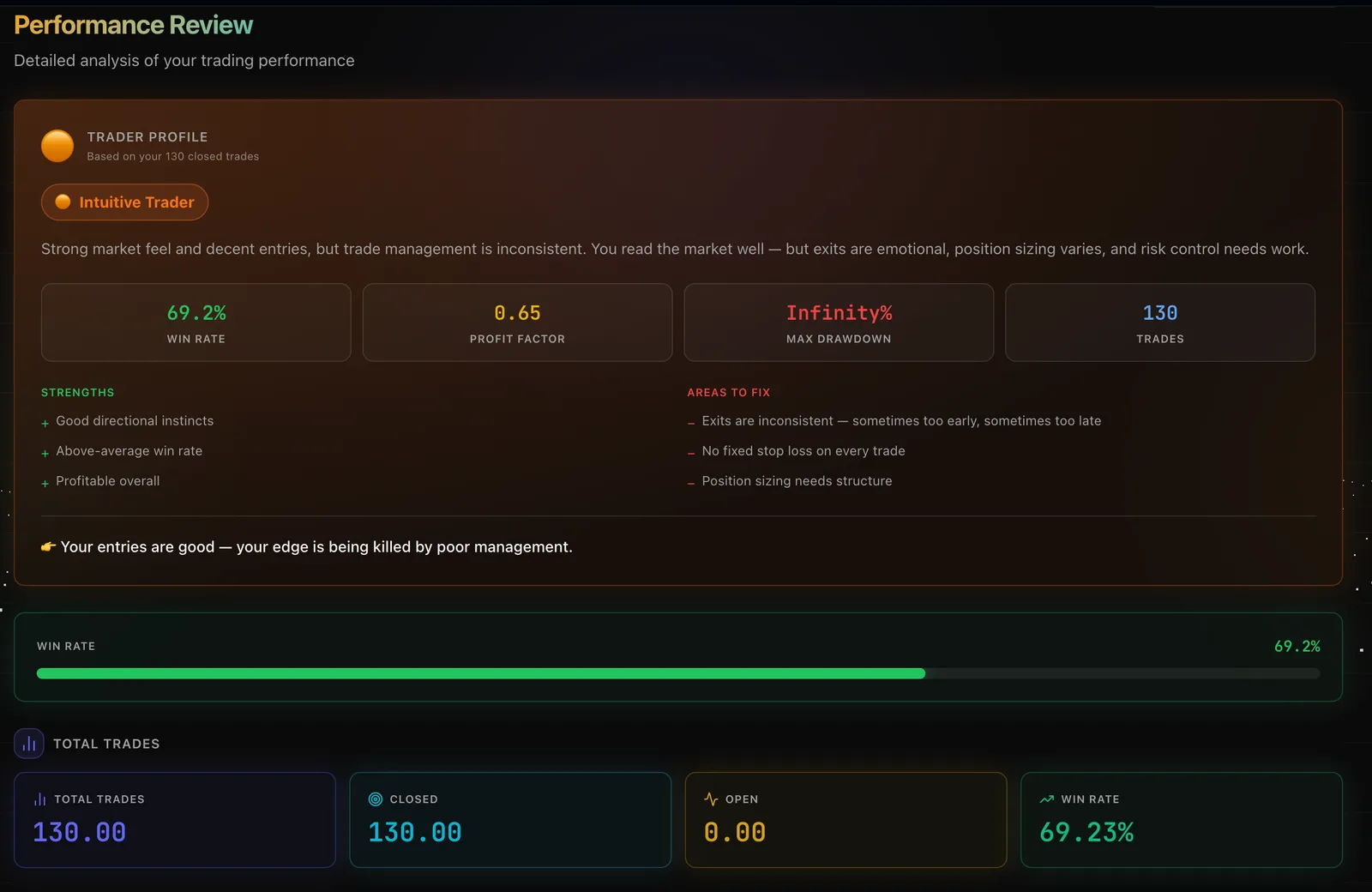
Look at that breakdown closely, because it shows why statistics exist at all. A 69% win rate looks excellent, almost seven winners out of ten. But a profit factor of 0.65 means this account is losing money: the winners are closed early and small while the losers are allowed to run. No trader sees that by recalling their trades. Memory preserves «I am right more often than not», not «I am bleeding on exits».
The hybrid nobody mentions
The choice does not have to be final. A very workable arrangement: the main part of your capital goes into the investing side on DCA with a two to five year horizon, while a small, pre-defined amount funds your trading education. That amount has to be small enough that losing it would not change your life, because in the first year it probably will shrink.
This structure solves the beginner's core problem: it removes the pressure. When every financial hope you have sits in a trading account, you start trading out of need — and trading out of need always ends the same way. When the main capital is quietly working somewhere else, learning to trade stops being a survival exam.
How to find out which one you actually are
Self-assessment almost always lies here, and it lies in one direction. Nearly everyone believes they are disciplined until the first losing streak. So numbers work better than introspection.
A simple one-month test. Keep a journal and write down every action you take in the market along with its reason. At the end of the month, count how many entries followed a rule you had written in advance and how many came from «it looked like it would move», «I was tired of waiting» or «I needed to win it back». If the second group is more than half, you have your answer, and it is not about intelligence. It is about temperament.
That is a perfectly adult answer. A DCA investor who never panicked in five years and kept buying calmly earns more than a trader who restarts from scratch every month. Choosing to invest is not losing. Losing is spending years doing what contradicts your character and then being surprised by the result.
Neuro Trader supports both paths
We deliberately built the platform so that it never forces you to be a trader.
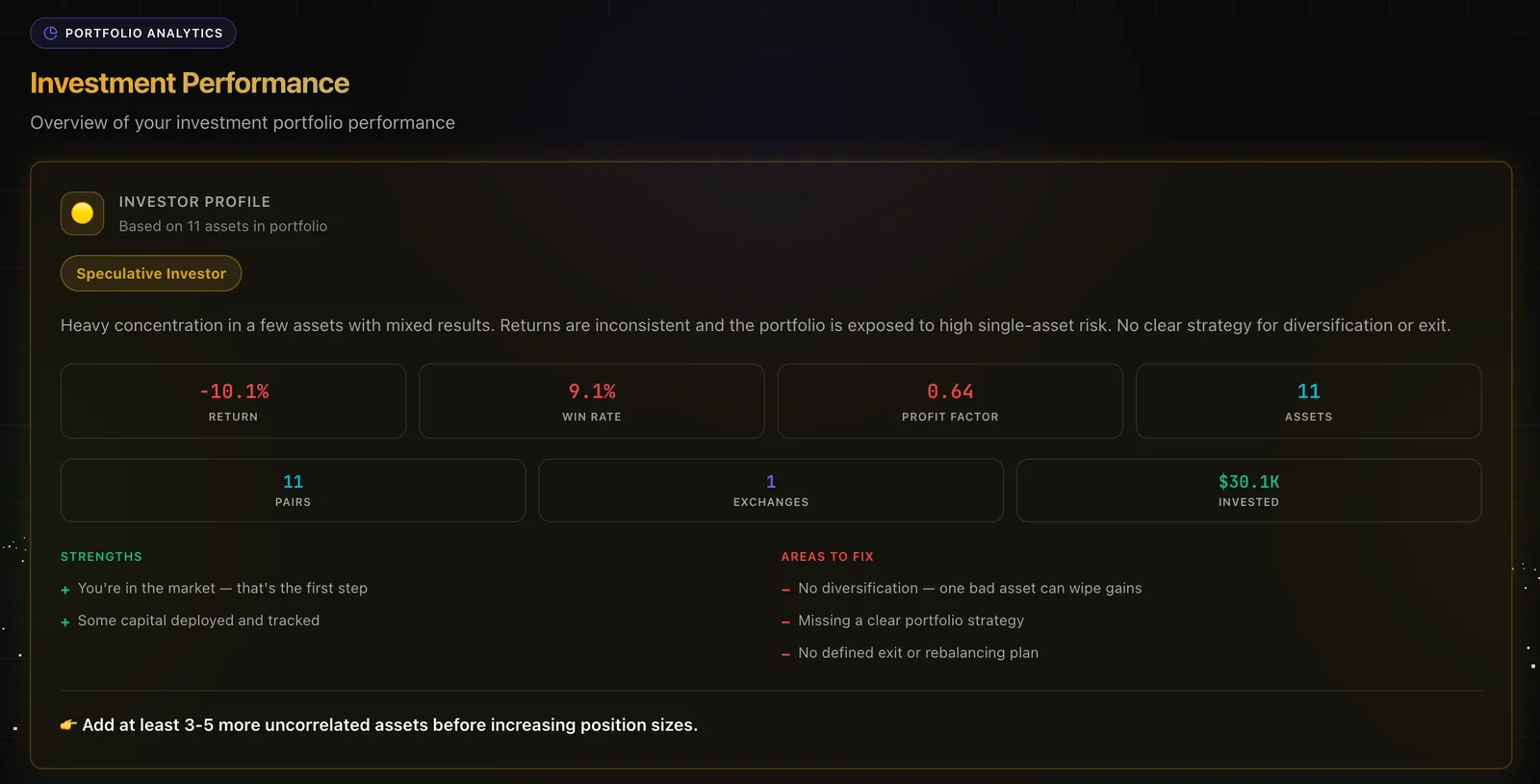
If you choose investing, the project has a dedicated investing side: an investor portfolio for tracking assets, a calculator for sizing contributions, and portfolio analytics — the investor profile from the screenshot above, showing concentration, diversification and the actual return on every position you build up in steps.
If you choose trading, there is a trading journal with per-trade review, a trader profile with win rate and profit factor statistics, and analytical market briefings: the aggregate forecast, market structure and a dozen indicators that collect the data for you.
Pick the path that matches your character, not the one that sounds more impressive. The money counts the same in both.
Investor or trader — the platform works for both
Portfolio tracking and investment analytics if you buy for years. A trading journal and market analytics if you trade.