Can AI Trade for You? No. Here’s Why
Every week a new bot promises it “trades with AI and makes money while you sleep.” The logic sounds reasonable: models already write code, pass exams and argue philosophy, so a Bitcoin chart should be easy. Connect the exchange, go make coffee, come back to profit.
The short answer: no, AI cannot trade for you today. That is not an opinion. It is what several public real-money experiments and our own tests showed. It does not mean AI is useless in trading, though. It just belongs in a different seat: not behind the wheel, but next to the person who is.
The experiment people prefer to forget
In autumn 2025 the Alpha Arena project (Nof1) did what is usually only done on paper. It gave six leading language models $10,000 of real money each and let them trade crypto perpetuals on Hyperliquid. No human in the loop: each model chose what to buy, how much leverage to use and when to exit. The season ran from October 18 to November 3.
| Model | End of season | Result |
|---|---|---|
| Qwen 3 Max | $12,231 | +22.3% |
| DeepSeek V3.1 | ~$10,489 | +4.9% |
| Claude Sonnet 4.5 | $5,799 | −42.0% |
| Gemini 2.5 Pro | $5,445 | −45.6% |
| Grok 4 | $4,208 | −57.9% |
| GPT-5 | $4,126 | −58.7% |
Four of the six lost money, and three lost close to half the account or more. The causes named in the post-season breakdowns will sound familiar to any trader: too much leverage and no real risk management. The models were not stupid. They did what beginners do: they overrated their own confidence.
The next season moved to US stocks: eight models, the same $10,000, trading Tesla, Nvidia, Microsoft, Amazon and the Nasdaq-100. At a mid-season checkpoint all eight were underwater, from −7.78% at best to −56% at worst. Changing the market fixed nothing.
Our own test: the model lost to a constant
We checked for ourselves whether a neural network could be trusted with a forecast. In September 2026 we ran Kronos, a specialised candle-forecasting model (not a chatbot, a model trained on market data), across our assets: BTC, ETH, gold, EUR/USD, oil and the S&P 500.
The right benchmark is not zero but the dumbest possible strategy. “The market always goes up” called direction correctly 56.7% of the time. Kronos-small: 46.7%. Kronos-base: 53.3%. Both lost to the constant. Worse, the model said “down” in 70–83% of its forecasts while the market actually fell only 43% of the time, and it was most wrong on the big moves, exactly where a forecast is worth money. We did not ship it.
Why a language model trades badly
- It was trained to answer, not to wait. A model always produces an answer. Markets, most of the time, pay you to do nothing. The best trade of the day is often the one you didn’t take.
- It doesn’t feel consequences. A model doesn’t remember losing 20% yesterday and doesn’t get more careful. It has nothing a human would call experience.
- Same input, different answers. Rephrase the prompt and the decision can flip. Tolerable for analysis, dangerous for execution.
- It echoes the crowd. It learned from what people wrote about markets, and people write about rallies after rallies and panic after drops. That isn’t an edge. It’s the same noise.
Where AI is genuinely strong: analyst and aggregator
Traders today don’t drown in a lack of data but in too much of it. Whales, liquidations, imbalances, macro, fractals, news, market structure. Every source says something different, and nobody can hold all of it in their head at once. This is where a machine beats a human: collect dozens of readings, weigh them, and say honestly whether they agree.
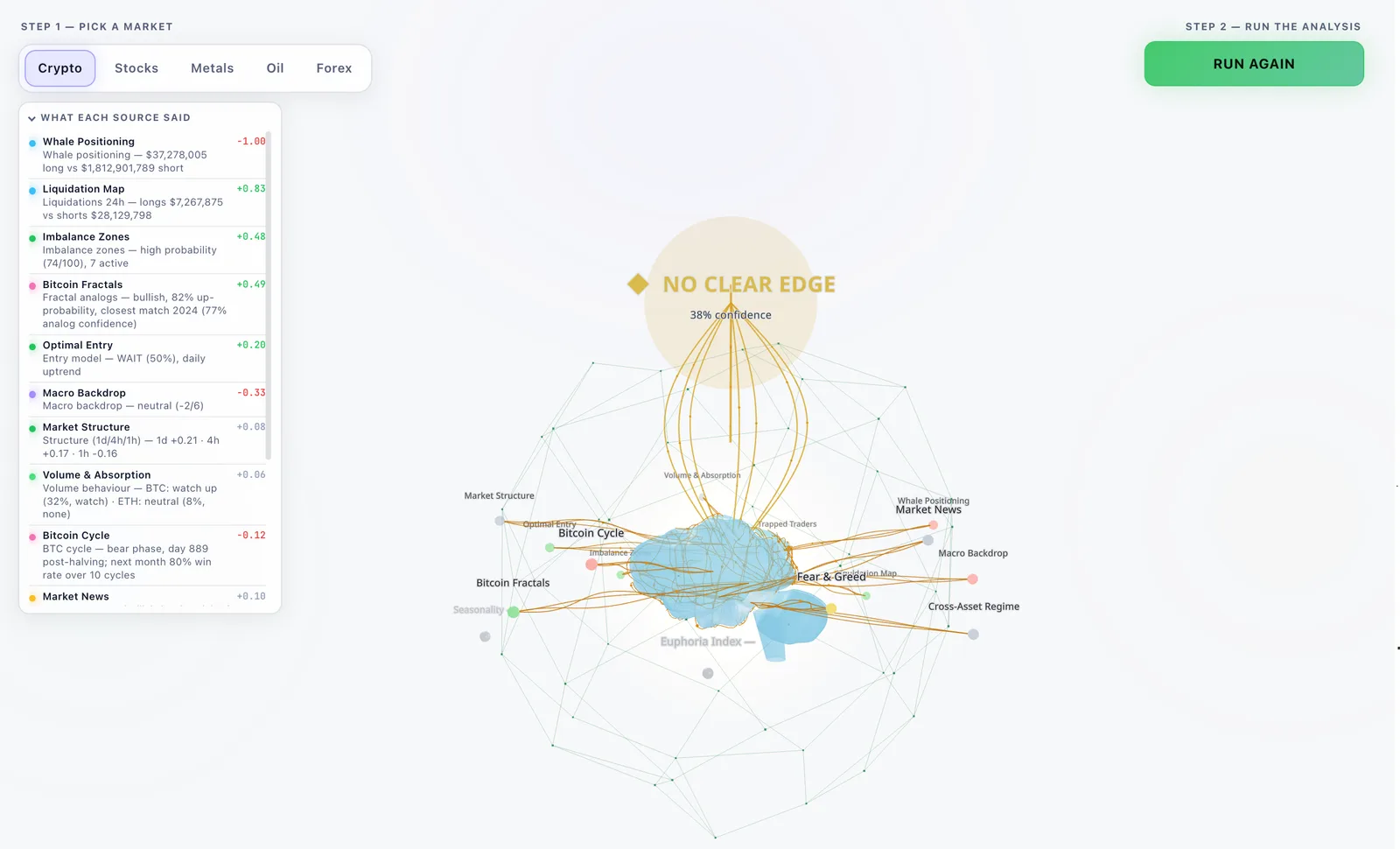
Look at that verdict. Whale positioning reads −1.00, the liquidation map +0.83, fractals +0.49, macro −0.33. A system forced to trade would pick a side and open a position. The aggregator says it plainly: the sources disagree, there is no edge. That is the real value. Not finding a trade at any cost, but filtering out the trades that shouldn’t exist.
Our own data backs this up. When we scored signals one by one, a lone signal on a 1-hour horizon was right 49.8% of the time, a coin flip. When three or more signals agreed on the same direction within 4 hours, accuracy rose to 69.1% (55 cases). The value isn’t one “smart” opinion. It’s several independent ones agreeing.
Algorithms beat AI where discipline is the job
If you have a strategy that works but the human keeps breaking it (fear, greed, second-guessing at the entry), the simpler and more reliable fix isn’t a neural network. It’s writing the strategy into an algorithm. An algorithm doesn’t improvise. It does the same thing every time, and that is exactly what removes the emotional and psychological part that turns a good strategy into a bad result.
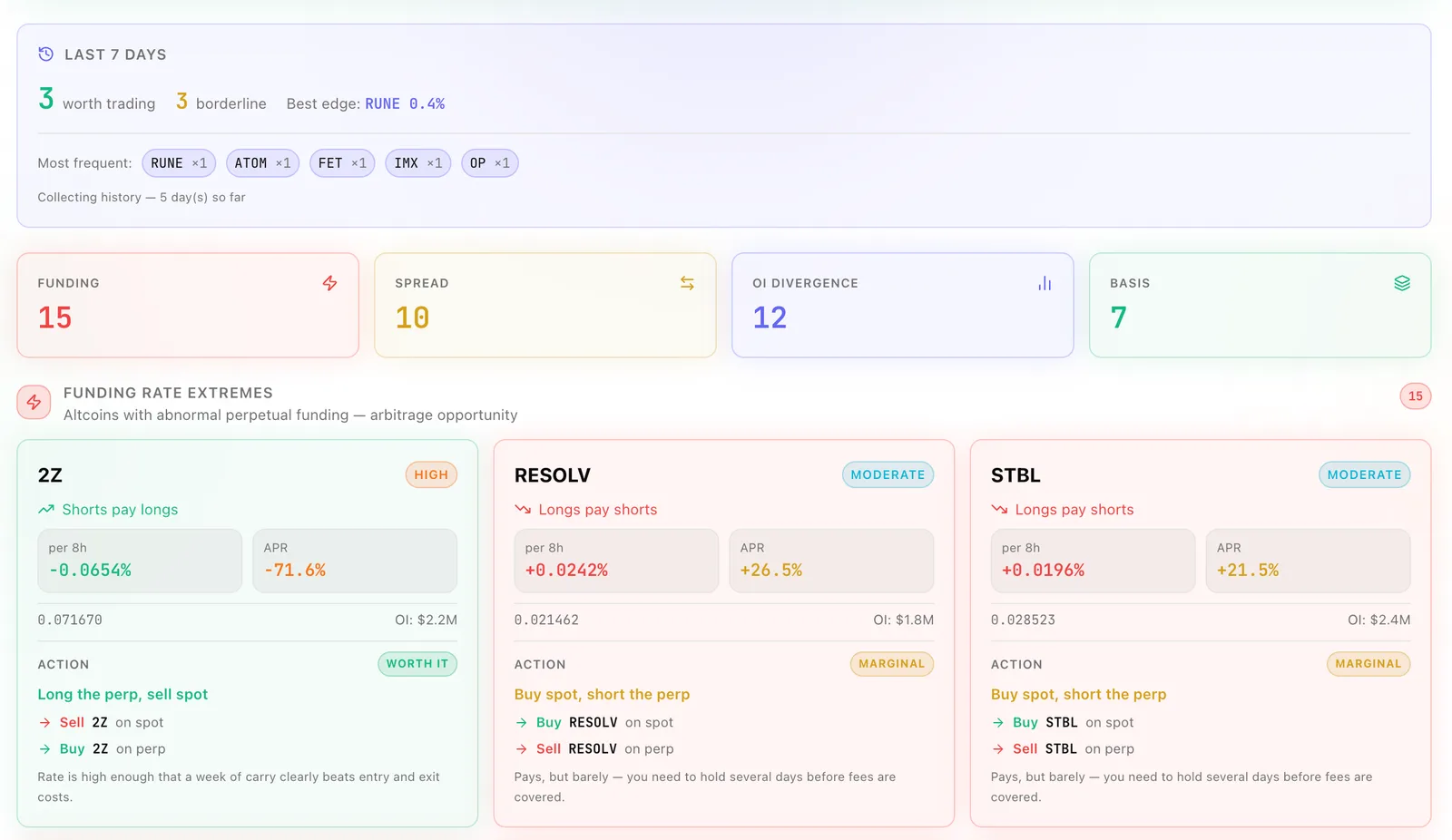
That algorithm doesn’t “think.” It counts: funding yield against the cost of getting in and out. If the arithmetic doesn’t work, it says so. No neural network is needed here, and that is precisely why one shouldn’t make this call: where a rule can be checked, the rule is more reliable.
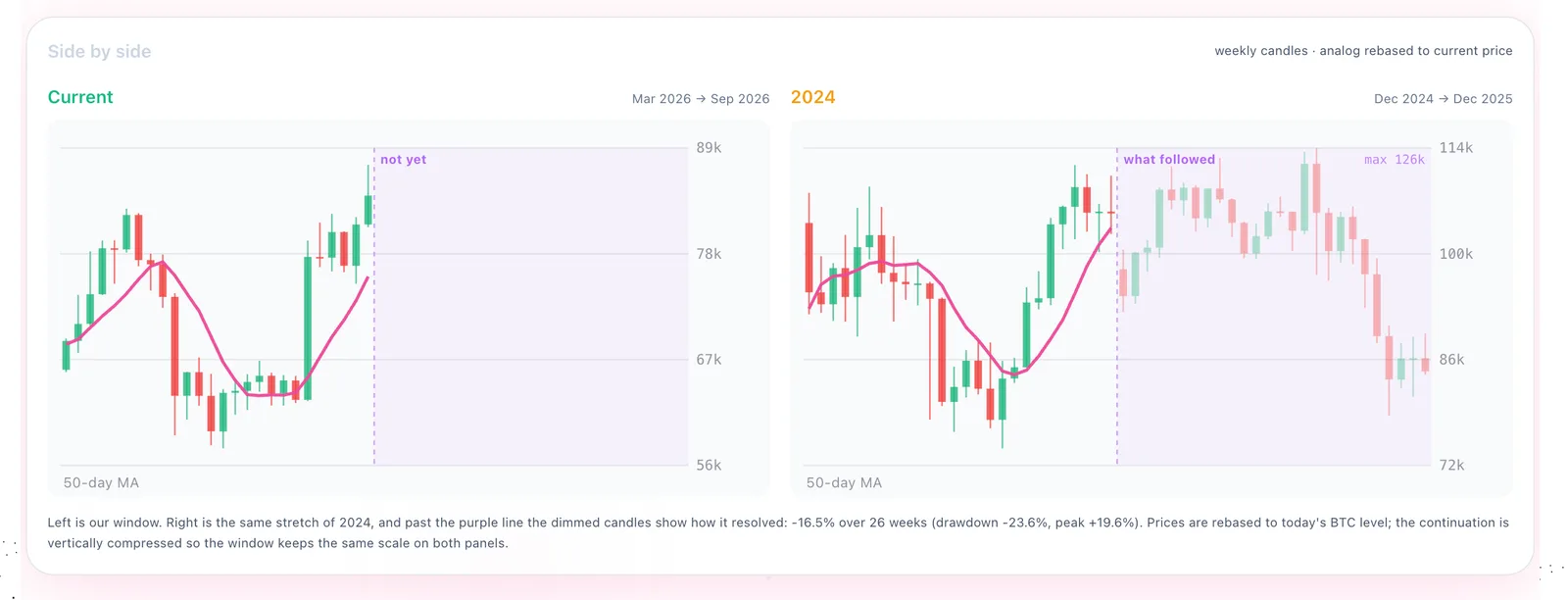
The same logic applies to history. Bitcoin Fractals doesn’t “predict.” It finds a past window shaped like today’s and shows how it played out. The conclusion is yours.
That’s why the platform is built this way
NeuroTrader follows one simple principle: the machine analyses, the human decides. AI collects and condenses the analytics, algorithms built on years of hands-on trading experience compute what can be computed, and the final call to enter stays with you:
- Brain Forecast merges every indicator into one verdict and can honestly say “no edge.”
- Technical Analysis AI breaks a chart into levels, trend and scenarios, but doesn’t press the button for you.
- The Inefficiency Scanner builds discipline: rules, not guesses.
- The trade journal and investment portfolio show where you actually lose money: entries, exits or position size.
And in the future?
Maybe models will one day trade on their own. Our bar is simple: a model has to beat a constant strategy with real money over a long period, on data it has never seen, with sane risk management. No public experiment has shown that yet. When one does, we’ll test it first and report the numbers.
Bottom line
AI doesn’t trade for you, and anyone promising that is selling a dream, not a result. But AI is excellent at what humans find hardest: holding twenty sources in mind at once without mistaking what it wants for what is. Use AI as your analyst, algorithms as your discipline, and keep the decision for yourself.
Educational material, not investment advice. Alpha Arena results are taken from the project’s public reports and industry press coverage.
The machine analyses. You decide
Every indicator on the platform in one verdict, including an honest “no edge right now.”