How to Use NeuroTrader: From Knowing Risk Management to Your First Journaled Trade
Most people who show up to trade already have some knowledge. You know you shouldn't risk more than 1-2% per trade. You've heard about money management. You might even have a strategy or a set of indicators you trust. But there's a gap between "I know the theory" and "I'm confidently clicking enter." It's not clear exactly where to start today: which asset to look at, which timeframe to read for direction, where exactly to enter, and how much to put on the trade.
NeuroTrader closes that exact gap. It doesn't replace your strategy — it plugs into it at every step, from reading market direction to reviewing the trade after it closes. Below is the full path, walked through on a real example, from opening the platform to logging the journal entry.
Step 1. Market Direction — AI Trading Bot V3
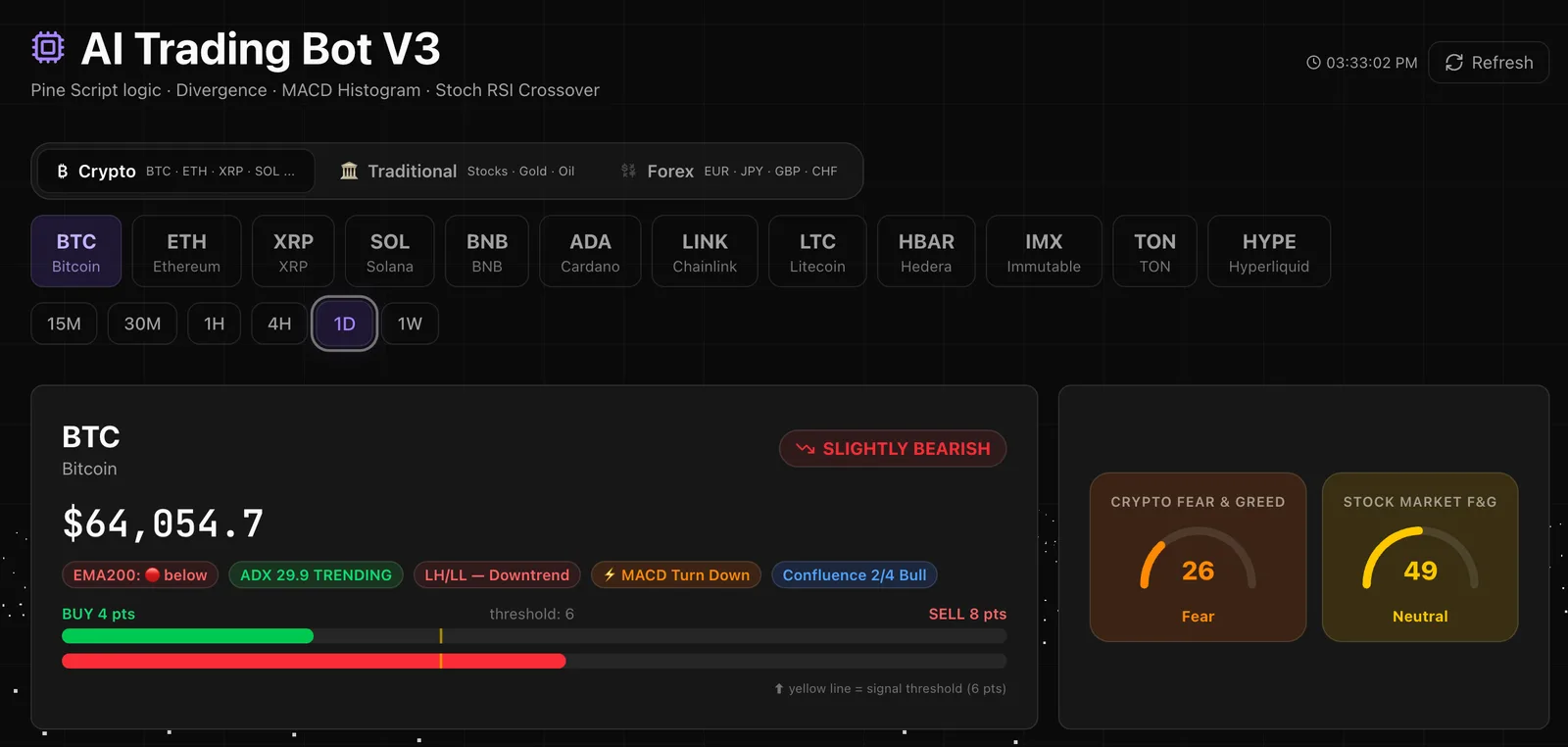
The first question of any day is buy, sell, or wait. AI Trading Bot V3 answers it using logic built in Pine Script: divergences, the MACD histogram, and Stoch RSI crossovers. Pick an asset (crypto, traditional markets — stocks/gold/oil, or forex) and a timeframe, from 15-minute scalping to a weekly swing view.
In the screenshot, it's BTC on the daily timeframe: price $64,054.7, status "Slightly Bearish." Below that is the badge row the decision is built from: price is below EMA200, ADX at 29.9 confirms the trend is actually moving (not a flat range), the LH/LL structure signals a downtrend, and MACD is turning down. The result is Confluence 2/4 Bull — only 2 of 4 factors sit on the buyers' side.
Below that is the BUY vs SELL score bar against the signal threshold (6 points in this example). Right now it's 4 points for buy against 8 for sell — clearly tilted toward sell, but not yet a full breach of the threshold, which is why the status reads "slightly bearish" rather than a hard SELL. On the right, separate Fear & Greed gauges for crypto and stocks give you the psychological backdrop, not just the technicals.
How to use it
The bot doesn't say "enter now" — it gives you context: which direction is currently favored and how confidently. Use it as a direction filter before you go looking for an entry.
Step 2. Trend on the Higher Timeframe, Entry on the Lower — Market Structure
This is where the classic multi-timeframe approach kicks in: read the trend on the higher timeframe, then hunt for the precise entry on a lower one. The Market Structure section formalizes this into a four-condition checklist run in sequence: 1D trend (2 swing points) → pullback to trend → 15m swing (lookback = 6) → Market Structure Shift → "Enter."
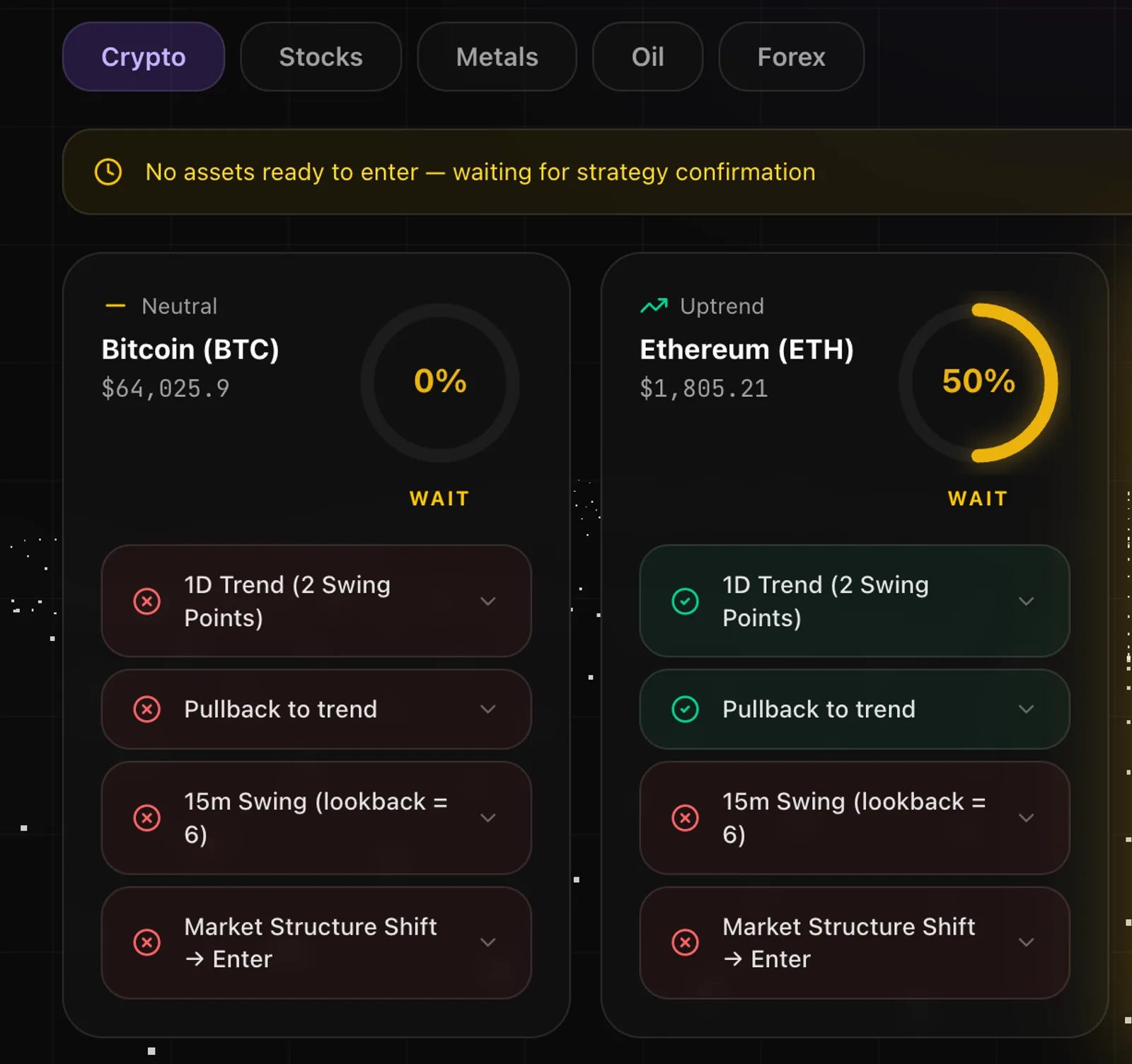
The screenshot shows the difference between two assets clearly: BTC has 0 of 4 conditions confirmed (the 1D trend hasn't formed in the right direction yet) — status "Neutral / WAIT." ETH has the 1D trend confirmed and the pullback to trend has also triggered — 50% progress toward the signal — but the structure shift at entry hasn't happened yet, so it's also flagged "WAIT" rather than "Enter." The banner up top says it plainly: "No assets ready to enter — waiting for strategy confirmation."
This is the core of the approach: the platform doesn't bend the signal to match what you want to see. Until every condition across every timeframe is met, entry doesn't light up — even if part of the checklist is already green.
Step 3. Pattern Indicators — like Three Drives BTC
Beyond general market structure, NeuroTrader ships focused indicators built for specific patterns — like Three Drives, a harmonic reversal pattern. The logic is the same multi-timeframe layering: the pattern forms on 4H (three consecutive drives, each extending further than the last), context is confirmed on 1D (higher-timeframe trend), and the entry is hunted on 1H through order flow.
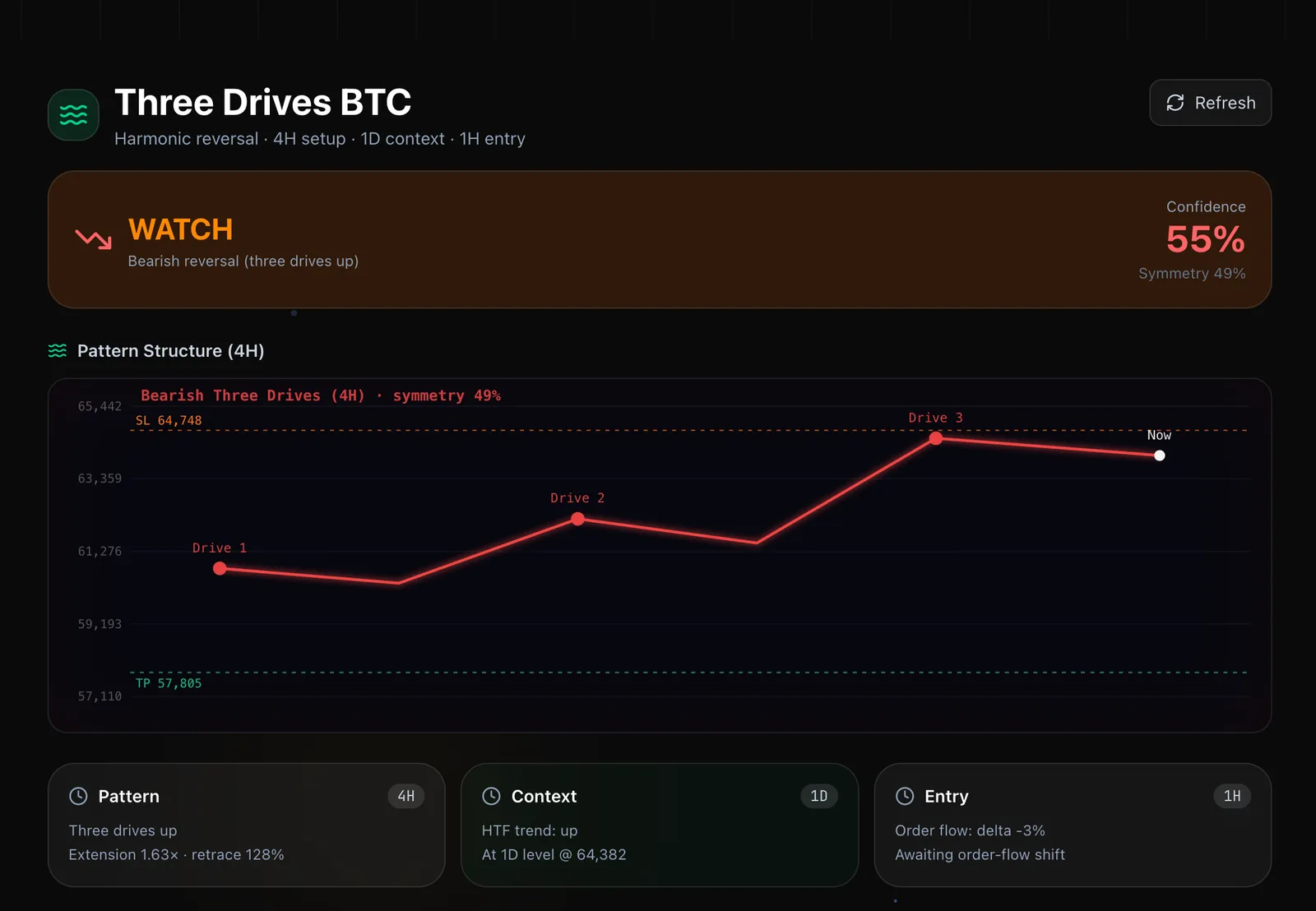
In this example: a bearish Three Drives on BTC (4H), 55% confidence, 49% drive symmetry. Status is "WATCH," not "Enter" — the pattern is formed (three drives clearly visible on the chart, with stop-loss and take-profit levels marked), the higher-timeframe trend is up (context confirmed), but order flow on the 1H entry timeframe hasn't triggered yet — the platform states it plainly: "Awaiting order-flow shift." Just like Market Structure, a signal only fires once all three layers line up: pattern, context, entry.
Similar pattern and setup indicators exist across other assets too, not just BTC. The logic is the same everywhere: don't guess off one timeframe — require confirmation at every level.
Step 4. Sizing the Risk — Risk Calculator
Direction and entry are set — now comes the risk and money management everyone knows in theory. The journal's Risk Calculator turns that theory into concrete numbers before you enter the trade.
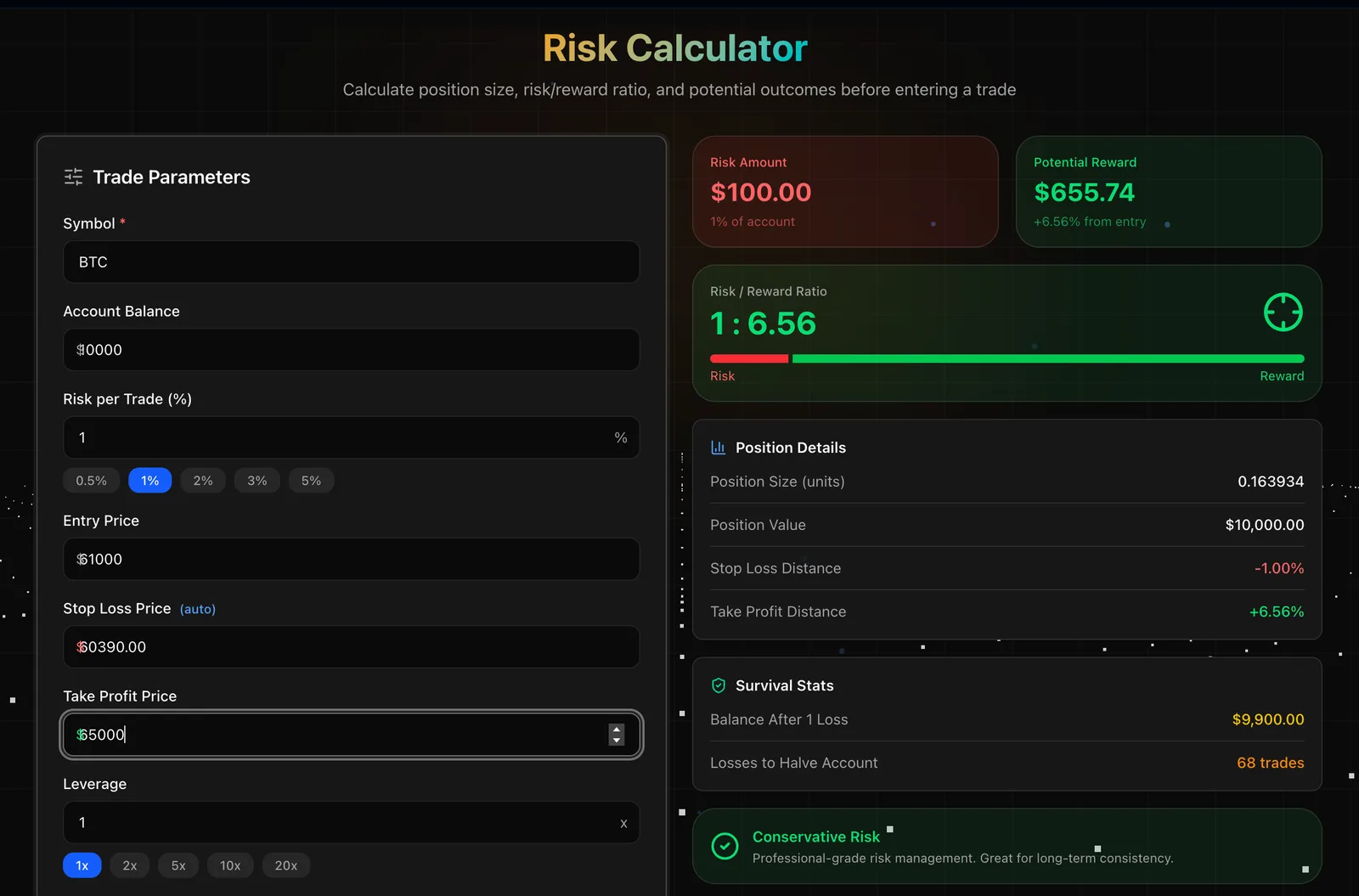
Enter account balance, risk per trade (presets at 0.5% / 1% / 2% / 3% / 5%), entry price, stop-loss, and take-profit — the calculator immediately gives you position size in units and dollars, the risk/reward ratio (1:6.56 in the example — a strong ratio), and a "Survival Stats" block: what your balance looks like after one loss, and how many consecutive losing trades it would take to halve your account (68 trades at 1% risk in this example). Below that, an honest read on the risk profile: "Conservative Risk — professional-grade risk management, great for long-term consistency."
This is the exact moment risk management stops being an abstract rule and becomes a concrete lot size on a specific trade.
Step 5. Trade Closed — Journal and AI Review
Trade executed, closed in profit or loss — this is where most traders stop. In NeuroTrader, the trade gets logged in the trade journal, and then AI analyzes it: how clean the execution was against the plan, whether the trade matched your setup or was an impulsive entry, whether risk and exit levels were respected, and which mistakes keep repeating trade after trade.
This turns the journal from a simple profit/loss list into a learning tool — you see not just the outcome, but the quality of the process that produced it.
Step 6. If That's Not Enough — Trading Couch
Sometimes a breakdown of the numbers isn't enough — especially after a losing streak, or a trade that's still sitting in your head. That's what Trading Couch is for — NeuroTrader's built-in AI trading psychologist. You describe what happened and how you feel, and get a psychology-first breakdown: the cognitive bias is named (revenge trading, FOMO, loss aversion), what went wrong is unpacked, and you get concrete steps to get discipline back.
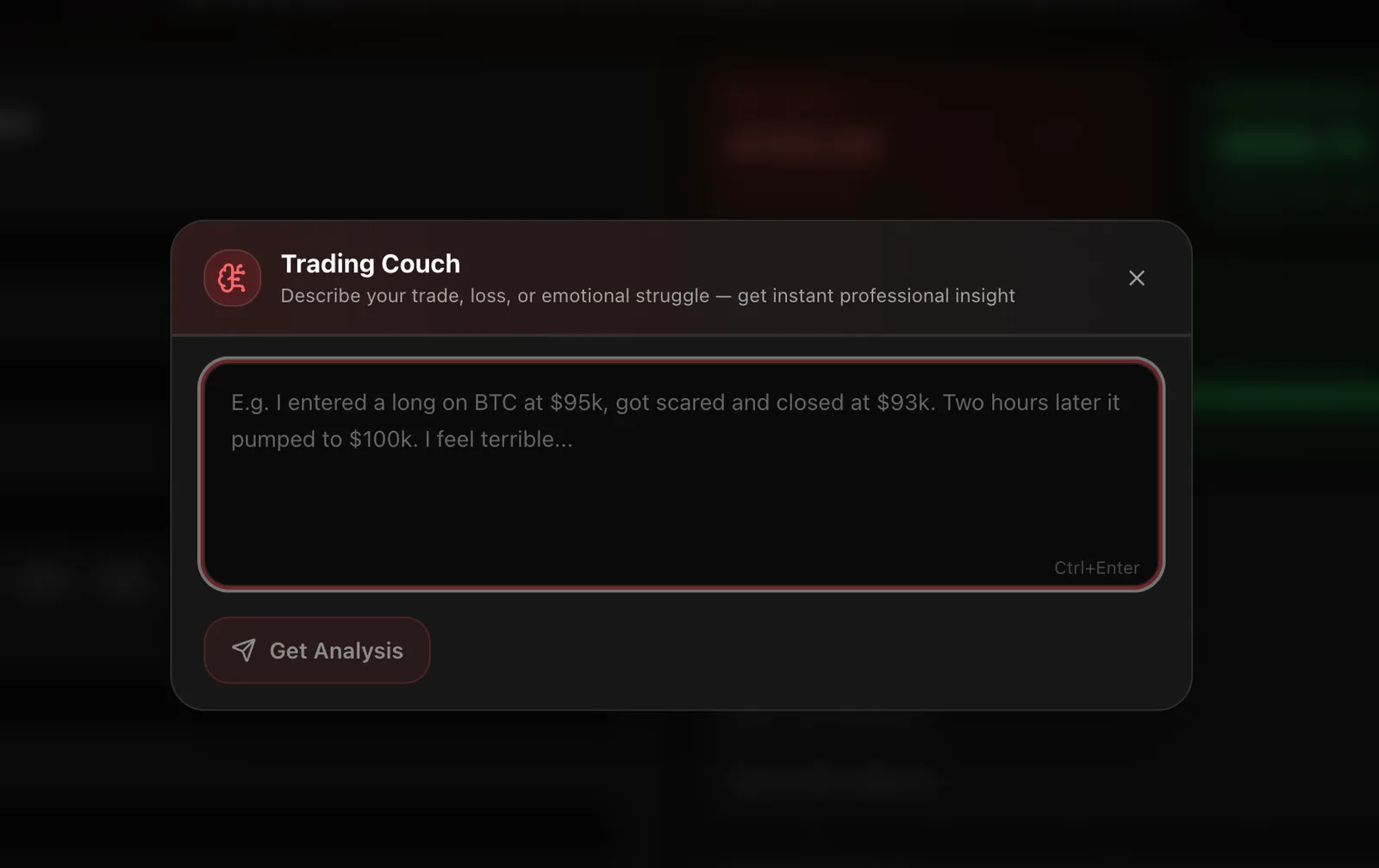
This means the journal covers not just the technical side ("what went wrong in the trade") but the emotional side too ("what was going on in my head") — both matter equally if you want to stop repeating the same mistakes.
Bonus: Telegram Signals
After signing up, you're automatically added to NeuroTrader's Telegram group, where signals for tracked patterns and structures land as they trigger — the same setup types visible on the platform (Market Structure, Three Drives, and others), delivered as a notification rather than requiring a tab to stay open all day. It helps you not miss the moment the whole checklist finally lines up.
Where to Start Right Now
Sign up, open the AI Trading Bot, and check the current signal on your asset. Then confirm direction with Market Structure, size the position in the Risk Calculator — and only then enter the trade.
Knowing risk management and money management is half the job. NeuroTrader is built for the other half: concrete steps, concrete numbers, and an honest review after every trade.